
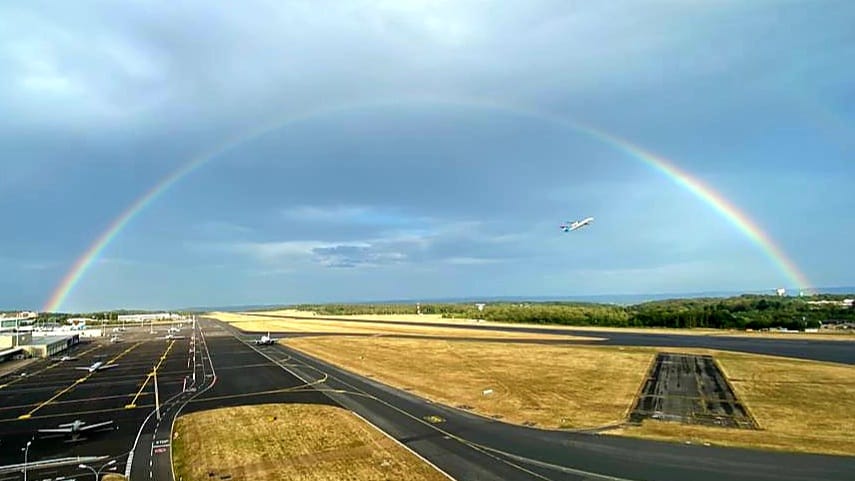
Luxembourg Airport (ELLX) is often perceived as a small European airport, but from an air traffic control perspective, it is far more complex than it appears.
Handling around 100,000 aircraft movements per year on a single runway, the airport combines commercial aviation, one of Europe’s largest cargo operations, general aviation, and helicopter services within the same airspace. In addition, Luxembourg frequently experiences fog, yet the airport is equipped for low visibility operations (CAT II/III), allowing aircraft to operate safely even in conditions with little visibility.
This unique mix of traffic density, weather conditions, and infrastructure makes Luxembourg Airport one of the most operationally demanding single-runway airports in Europe.
Luxembourg Airport Overview
Luxembourg Airport (IATA: LUX, ICAO: ELLX), located in Findel, is the Grand Duchy’s only international airport and a critical infrastructure hub.
Key technical data
- Runway: 06/24 (single runway)
- Length: approx. 4,000 meters
- Width: 45 meters
- Annual traffic: ~100,000 aircraft movements
Despite having only one runway, the airport supports a wide range of operations typically seen at much larger airports.
A Major Cargo Hub in Europe
Luxembourg Airport plays a disproportionately large role in global air freight.
It is consistently ranked among the top cargo airports in Europe and frequently appears within the top 30 worldwide by cargo tonnage.
The airport serves as the home base of Cargolux, which operates a fleet of Boeing 747 freighters, making widebody heavy aircraft a routine part of daily operations.
ATC Perspective: A Single Runway, Maximum Complexity
From an air traffic control (ATC) perspective, Luxembourg Airport is a textbook example of operational complexity. The day in the life of a tower controller illustrates how sequencing, coordination, and workload management are handled in real operations.
All arrivals and departures must be handled on a single runway, requiring precise sequencing, spacing, and coordination between tower and approach control.
Unlike multi-runway airports, there is no possibility to distribute traffic flows – every aircraft must fit into one continuous sequence.
Mixed Traffic Operations
Aircraft categories at Luxembourg Airport:
- Light aircraft (Wake Turbulence Category L)
General aviation traffic such as the Cessna 172 - Medium aircraft (Category M)
Passenger flights operated by airlines like Luxair, Lufthansa or British Airways - Heavy aircraft (Category H)
Large cargo aircraft such as the Boeing 747 - Helicopter operations
Police and Luxembourg Air Rescue flights based directly at the airport
This diverse traffic mix is one of the key reasons why operations at Luxembourg Airport are particularly demanding.
Wake Turbulence and Separation Constraints
The mixed traffic environment introduces significant wake turbulence constraints.
Heavy aircraft generate strong wake vortices, requiring increased separation for following aircraft. For example:
- A light aircraft cannot operate directly behind a heavy aircraft
- Additional spacing reduces runway capacity
Controllers must continuously balance efficiency and safety while dynamically adjusting sequences depending on aircraft type and performance. These challenges are closely linked to human factors in air traffic control, including workload, situational awareness, and decision-making under pressure.
Why 100,000 Movements Is Significant
While around 100,000 aircraft movements per year may appear moderate compared to major international hubs, this figure is highly significant for a single-runway airport like Luxembourg.
With no parallel runway available, every arrival, departure, and runway crossing must be carefully sequenced. Any delay or additional spacing requirement directly affects the entire traffic flow, leaving little room for operational flexibility.
For comparison, London City Airport, which also operates a single runway, handles roughly 50,000–80,000 aircraft movements per year in recent years. Luxembourg Airport therefore operates within a higher range, but with a more diverse traffic mix including heavy cargo aircraft.
A comparable example is Milan Bergamo Airport (BGY), the third-busiest airport in Italy, which operates two runways and recorded around 110,000 aircraft movements. Despite having more runway infrastructure, its traffic levels are similar to Luxembourg Airport, highlighting how operational complexity at ELLX is driven not only by volume, but by traffic mix and single-runway constraints.
This combination of traffic density, aircraft diversity, and infrastructure limitations makes Luxembourg Airport a high-intensity operational environment for air traffic control.
Runway Crossings and Ground Movement Complexity
In recent years, ground operations at Luxembourg Airport have become increasingly complex due to infrastructure expansion.
Both Luxair and Cargolux have developed new hangars and operational facilities located on the opposite side of the runway. As a result, aircraft and vehicles frequently need to cross the active runway to access these areas.
These runway crossings add an additional layer of complexity for air traffic controllers. Every crossing must be carefully coordinated with arriving and departing traffic, often requiring temporary gaps in the sequence.
At a single-runway airport with already high traffic density, even small disruptions can have a cascading effect on overall flow management, making efficient ground coordination a critical part of ATC operations at Luxembourg Airport.
Historical Development of Luxembourg Airport
Luxembourg Airport has evolved significantly over the decades.
Historical photographs from the 1950s show a much smaller airfield with limited infrastructure, reflecting the early stages of aviation in Luxembourg.
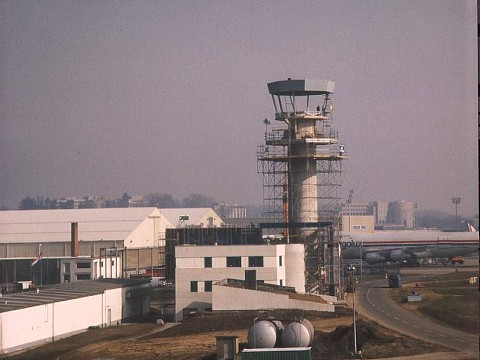
In the 1990s, the construction of the current control tower marked a major step in modernizing air traffic management capabilities.
This tower remains in operation today but is expected to be replaced by a new facility in the coming years.
The Future: Tower Replacement & Modernization
To meet future operational demands, Luxembourg Airport is planning to replace its current control tower with a new, modern facility.
This development reflects the increasing complexity of traffic and the need for advanced technologies in air traffic control. However, a remote tower is not considered a viable solution for Luxembourg Airport. The combination of dense traffic, heavy cargo operations, and highly mixed aircraft types requires direct visual control and immediate situational awareness that cannot be fully replicated remotely. The remote tower feasibility study at Luxembourg Airport clearly outlines these operational constraints.
Why Luxembourg Airport Is More Complex Than It Looks
Luxembourg Airport is far more than a regional airport, it is a highly specialized and fast-growing international aviation hub.
Its combination of high cargo volumes, mixed aircraft types, runway crossings, and single-runway operations creates a uniquely complex environment for air traffic control.
For those looking beyond passenger numbers, ELLX represents a dynamic and technically demanding system that highlights the real-world challenges of modern ATC operations.
Read more: Luxembourg Airport: A Not So Small Airport with Big-Airport Complexity
FAQ
What is the runway length of Luxembourg Airport?
Luxembourg Airport has a single runway (06/24) with a length of approximately 4,000 meters.
How busy is Luxembourg Airport?
The airport handles around 100,000 aircraft movements per year.
Is Luxembourg Airport a cargo hub?
Yes, it is one of Europe’s major cargo hubs and ranks among the top cargo airports worldwide.