
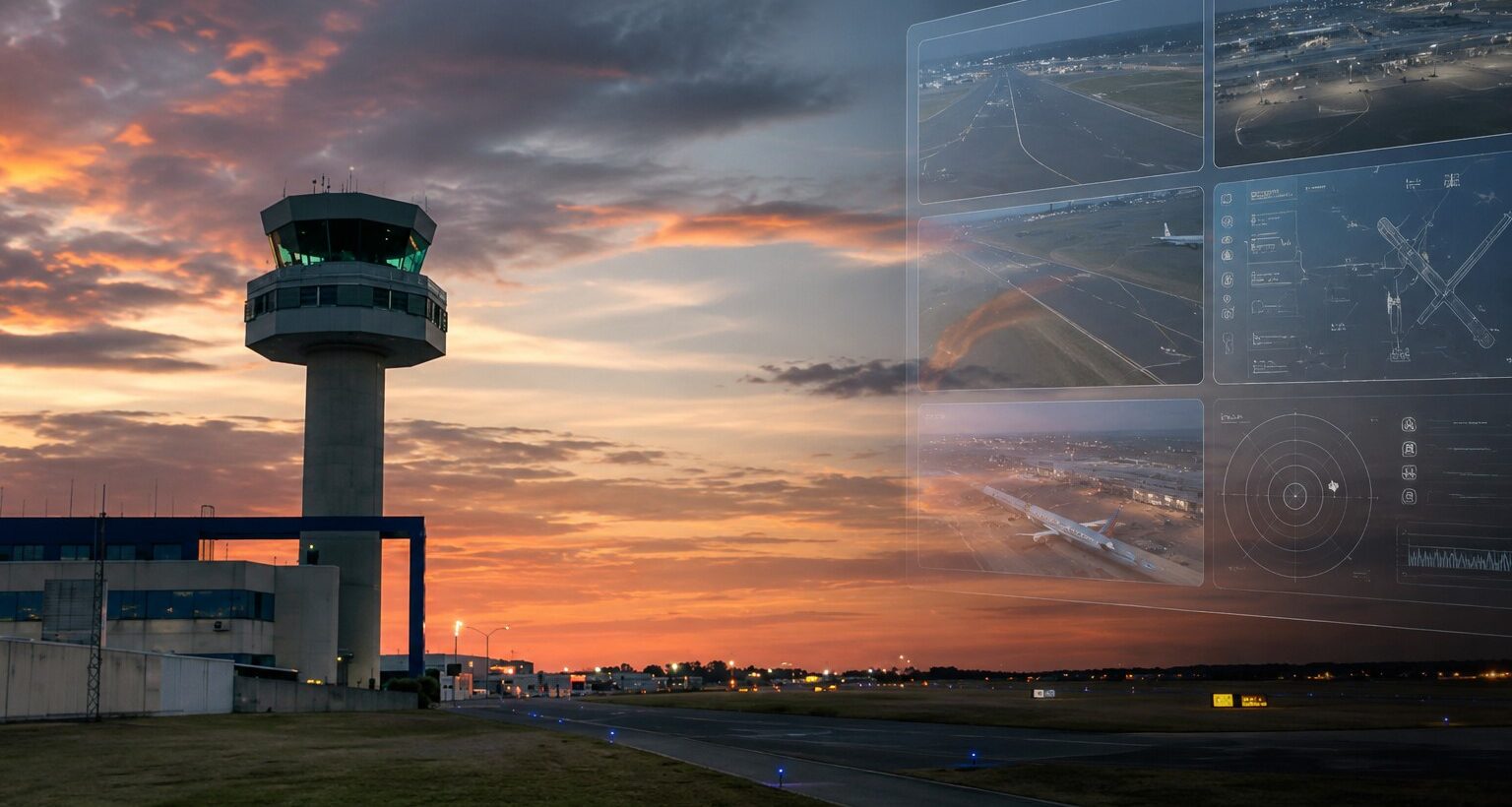
The Guilde Luxembourgeoise des Contrôleurs de la Circulation Aérienne (GLCCA) has closely monitored the development of remote tower technology in recent years. In doing so, we have actively followed industry developments, considered IFATCA and EASA guidance, and exchanged with European counterparts to assess whether such systems could realistically be suitable for Luxembourg Airport (ELLX).
With extensive experience in implementing both simple and complex air traffic control systems, the GLCCA can provide an operational perspective on the challenges of introducing new technology into a complex airport environment. This analysis is based on international standards, operational best practices and the specific characteristics of Luxembourg Airport.
Remote tower technology may offer advantages in certain situations, especially at small, low-complexity airports. However, Luxembourg Airport is not a simple airfield. It is the country’s only international airport, a major European cargo center, and a complex single-runway environment with heavy cargo operations, passenger traffic, mixed IFR and VFR operations, helicopters, training flights, military activity, CAT III low visibility operations and frequent runway crossings.
For high-traffic and operationally complex airports such as ELLX, current remote tower limitations significantly outweigh the proposed benefits. The main concerns relate to safety, operational compatibility, technical resilience, maintenance requirements and unproven economic advantages.
Main position
Remote towers may be useful for smaller and less complex aerodromes. Luxembourg Airport is different. ELLX combines heavy cargo aircraft, passenger traffic, helicopters, VFR traffic, training flights, military activity, CAT III operations and runway crossings on a single-runway system. Current remote tower technology is not yet proven for this level of operational complexity.
Safety Limitations
The first and most important concern is safety. A conventional control tower gives controllers direct visual observation of the airfield, supported by peripheral vision, depth perception, natural light conditions, sound cues and immediate awareness of changes on the movement area.
A remote tower replaces this direct view with camera feeds, screens, sensors, networks and software. Even if the technology is advanced, this fundamentally changes how controllers perceive and interpret the airport environment.
Compromised Situational Awareness and Responsiveness
Virtual towers rely on camera feeds and therefore lack some of the direct visual and auditory cues available in a conventional tower, such as engine sounds, wind shifts, changing weather cues or the natural perception of aircraft movement across the airport environment.
Camera systems can also introduce delays, ranging from milliseconds to more than a second. In routine situations this may appear minor, but during dynamic operations, runway incursions, emergencies or unexpected aircraft movements, even small delays can affect the controller’s ability to react promptly.
At a high-traffic airport like ELLX, where heavy aircraft, passenger jets, VFR traffic, helicopters and vehicles may all interact with the same infrastructure, degraded situational awareness is a serious safety concern.
Situational awareness is more than a video image
Tower control is not based only on looking at aircraft. It also depends on peripheral vision, sound, movement anticipation, weather perception and the ability to understand the entire airport environment instantly. A camera feed cannot fully reproduce that operational picture.
System Vulnerabilities
Remote tower systems depend on cameras, networks, power supplies, displays and software. Failures in any of these elements can result in frozen images, blank screens or degraded visual information.
In a conventional tower, if a supporting system fails, controllers may still retain direct visual observation of the runway, taxiways and apron areas. In a remote tower, the visual environment itself depends on technical infrastructure.
This creates a very different risk profile. A camera, network or power failure during peak traffic or an emergency could force operations to stop or significantly reduce airport capacity.
Cybersecurity Threats
Because remote towers are network-dependent, they are exposed to cybersecurity risks such as data tampering, denial-of-service attacks, unauthorized access or manipulation of visual information.
A successful cyberattack could mislead controllers, disrupt camera feeds or compromise the integrity of operational data. For Luxembourg, this risk is particularly significant because ELLX is the country’s only international airport and also has national and military relevance.
A major cyber incident affecting the remote tower system could therefore disrupt not only civil aviation, but also national and military operations, potentially leaving Luxembourg without an operational international airport.
National resilience matters
ELLX is not one airport among many inside Luxembourg. It is the country’s sole international airport. Any technology that could reduce operational availability must therefore be assessed not only as an airport project, but also as a national resilience issue.
Susceptibility to Simple Disruptions
Remote tower systems can also be vulnerable to simple physical disruptions. Even something as basic as a handheld laser pointer aimed at a camera could temporarily blind or degrade the image.
This is especially relevant because remote tower cameras are often mounted on high masts and may be visible from long distances. A targeted laser aimed at a camera lens could impair situational awareness at a critical moment.
Such easily executed disruptions may be difficult to prevent completely, yet their operational consequences could be serious during runway operations, helicopter movements or emergency situations.
Weather-Related Limitations
Adverse weather is another major concern. Heavy rain, snow, glare, sudden storms, lightning, low sun angles, contamination or ice can degrade camera performance or even disable feeds.
Camera systems may struggle to provide the same reliable visibility of aircraft, vehicles, obstacles or runway conditions under difficult weather conditions. Conventional towers are also affected by weather, but controllers still retain a direct view of the real environment rather than relying entirely on camera sensors.
This is particularly important at Luxembourg Airport, where fog, low visibility and changing weather conditions are common operational factors.
Inadequate Detection of Hazards
Limited camera resolution, image quality issues and blind spots may reduce the ability to detect small hazards. These can include foreign object debris, wildlife, birds during migration, vehicles outside expected areas or aircraft incidents outside the primary camera focus.
Delayed detection of such hazards can increase the risk of runway contamination, bird strikes, runway incursions or delayed emergency response.
At an airport with a long runway, heavy cargo aircraft, VFR traffic, helicopter activity and ground movements, reliable hazard detection is essential.
Controller Fatigue and Cognitive Load
Remote tower operations also change the human factors environment. Controllers may need to monitor multiple screens, camera angles, overlays and alerts for extended periods.
Prolonged screen use, system lag and the need to mentally reconstruct the airport environment from camera views can increase cognitive strain. Over time, this may increase the risk of fatigue, errors or burnout.
This is particularly relevant during complex operations at busy airports, where controllers must continuously manage changing traffic, runway usage, VFR movements, helicopters and vehicles.
Human factors are operational factors
A remote tower is not only a technical project. It changes how controllers perceive traffic, detect conflicts, judge movement and maintain situational awareness. For complex airports, this human factors dimension is central.
Risk of Over-Reliance on Advanced Features
Remote tower concepts often rely on advanced features such as visual tracking, radar overlays, surveillance integration or automated alerting. These tools may be useful, but they can also create dependency.
If controllers become too dependent on advanced systems for situational awareness, a failure or degradation of those features could leave them less prepared to operate safely without them.
Without robust fallback procedures and proven contingency concepts, over-reliance on advanced features can compromise safety instead of improving it.
Operational Incompatibilities at ELLX
Remote tower systems are generally better suited to simpler airports with lower traffic density and less diverse operations. Luxembourg Airport does not fit that profile.
ELLX has a long runway of around 4,000 meters, approximately 100,000 annual movements, significant cargo activity and a highly diverse traffic mix. The airport combines commercial air transport, business aviation, general aviation, helicopter operations, training traffic and military activity.
Unsuitability for Complex Airports
Virtual towers are often designed around relatively simple operating environments. At ELLX, however, controllers must manage a complex combination of aircraft types, operational rules, runway crossings, VFR activity, helicopter movements and low visibility procedures.
The complexity is not only the number of movements. It is the diversity of traffic, the speed differences, the wake turbulence categories, the runway occupancy times and the operational consequences of any delay or system limitation.
Mixed and VFR Traffic
One of the strongest operational arguments against a remote tower at ELLX is the airport’s mixed traffic environment.
Controllers may need to manage student pilots, general aviation aircraft, helicopters, large passenger jets, heavy cargo aircraft and military flights within the same operating periods. VFR operations require direct judgment, rapid visual interpretation and the ability to anticipate less predictable aircraft behavior.
Due to limited visual fidelity, possible camera delay and reduced natural perception, remote tower systems may struggle to provide the same level of confidence for mixed IFR and VFR sequencing.
This could create risks of inadequate separation, delays, disruption to flight school activity, disruption to military operations and reduced flexibility in managing visual traffic.
Mixed traffic makes ELLX especially demanding
ELLX is not a homogeneous airline-only airport. It combines Boeing 747 freighters, passenger jets, Luxair turboprops, business aviation, student pilots, VFR traffic, helicopters and military flights. That diversity makes visual judgment and immediate situational awareness essential.
Inefficiencies in High-Traffic Operations
High movement volumes and visual separation requirements can reduce the efficiency of remote tower operations. If controllers need to apply wider spacing because of reduced visual confidence, latency or limited camera perspectives, traffic throughput will decrease.
For ELLX, this could undermine runway capacity and reduce operational efficiency. A system that forces more conservative procedures may appear modern, but it could reduce the airport’s practical capacity.
Ground Operation Challenges
Ground operations are a critical part of ELLX complexity. Camera blind spots, image delay or reduced resolution can make it more difficult to coordinate runway crossings, vehicle movements and taxiway operations precisely.
This increases the risk of undetected runway incursions or slower operational decisions, especially during busy periods or low visibility conditions.
At a single-runway airport, ground movements are not secondary. They directly influence runway availability, arrival spacing, departure sequencing and airport capacity.
Unplanned Flights, Training Traffic and Emergencies
Unexpected flights, emergency aircraft, training traffic and unpredictable VFR operations require real-time operational judgment. These situations often do not follow a standard pattern.
Controllers must quickly assess aircraft position, intention, speed, spacing, runway availability and possible conflicts. A remote tower system that reduces visual confidence or introduces delay may make these situations harder to manage.
Helicopter Operations
Helicopter operations are another major incompatibility concern at ELLX. Police and Air Rescue helicopters conduct VFR operations that require close coordination with runway and taxiway activity.
At Luxembourg Airport, helicopters may use active taxiway areas and require real-time precision from controllers. Such operations are difficult to manage through a remote tower system if visual fidelity, camera coverage or latency are not absolutely reliable.
For this reason, helicopter operations at ELLX represent one of the most demanding operational challenges for any remote tower concept.
Ground and helicopter operations are central at ELLX
Runway crossings, vehicle movements, helicopter operations and taxiway coordination are not minor background tasks. At a single-runway airport, they directly affect safety, capacity and operational continuity.
Limited Validation for Complex Scenarios
Existing SESAR validations and remote tower implementations have mainly focused on low- to medium-density airports with simpler layouts and less demanding traffic environments.
There is limited operational evidence proving that remote towers can safely and efficiently manage complex, high-traffic environments like ELLX, especially with heavy cargo, VFR traffic, helicopter operations, military activity and CAT III requirements.
This lack of validation creates significant uncertainty. Before such a system could be considered for Luxembourg, it would need to be proven at comparable airports under comparable operational conditions.
Increased Maintenance and Technical Demands
Remote towers are sometimes presented as a way to simplify airport infrastructure. In reality, they introduce a highly complex technical architecture that must operate continuously and reliably.
A remote tower requires cameras, sensors, networks, displays, power supplies, cybersecurity systems, monitoring tools, software, redundancy and backup procedures. Each of these elements must be maintained to aviation safety standards.
Continuous Technical Support Requirements
Remote towers require 24/7 operation of cameras, networks, power systems and display infrastructure. This requires dedicated technical teams with expertise in IT, cybersecurity, systems engineering, surveillance technology and operational support.
Rather than reducing complexity, a remote tower shifts complexity from a physical control tower into a technical system that requires continuous specialist maintenance.
Difficulty in Securing Qualified IT Personnel
The aviation sector already faces challenges in recruiting qualified technical personnel. Remote tower systems increase dependency on specialized IT staff, cybersecurity experts and systems engineers.
This risk is not theoretical. Skyguide’s Virtual Center program has faced major challenges and delays, with the shortage of specialized staff being one of the relevant factors. Although a virtual center is not the same as a virtual tower, it illustrates the wider difficulty of maintaining complex digital ATC infrastructure.
Ongoing Equipment Upkeep
Remote tower cameras require regular cleaning, calibration, maintenance and replacement. Weather, bird droppings, dust, precipitation, snow, ice and other environmental factors can degrade image quality.
Any degradation of the visual system can have direct operational consequences. Unlike a conventional tower window, a remote tower camera system is a safety-critical technical asset that requires constant upkeep.
Power Reliability and Redundancy
Uninterrupted primary and secondary power supplies are essential for remote tower operations. A reliable power architecture with backup systems, monitoring and redundancy is mandatory.
This adds cost and maintenance requirements, particularly in an environment where weather disruptions, lightning or technical faults can affect infrastructure availability.
Complex Technical Architecture
Integrating visual surveillance, camera feeds, network transmission, display systems, recording, cybersecurity and backup systems creates a complex technical architecture.
Every part of that chain must work reliably. A weakness in one element can affect the entire operational concept. This increases the need for redundancy and raises the risk of single points of failure if not designed and maintained properly.
Remote does not mean simple
A remote tower removes the physical tower viewpoint, but replaces it with cameras, masts, networks, software, power systems, cybersecurity layers and display infrastructure. Every link in that chain becomes operationally critical.
Camera Placement Constraints
Camera placement is not always straightforward. Cameras installed in or near runway safety areas must comply with strict regulatory requirements. They may need to be frangible, protected, positioned correctly and maintained without creating new hazards.
The example of the 46-meter camera mast at Liège Airport illustrates these infrastructure and regulatory challenges. The project has already been delayed by more than two years, showing that remote tower infrastructure can be complex, slow and difficult to implement in practice.
Unproven Economic Benefits
The economic argument for remote towers is often presented as simple: reduce infrastructure cost and centralize operations. For a complex airport like ELLX, this claim is far from proven.
High Initial and Ongoing Costs
Deploying a remote tower requires high-resolution cameras, masts, networks, control room workstations, redundancy, cybersecurity measures, integration work, certification, training and testing.
Ongoing costs include maintenance, software upgrades, cybersecurity, technical staffing, equipment replacement and supplier support. When all these factors are considered, the total cost may rival or even exceed the cost of a conventional tower solution.
Supplier Dependency Risks
Remote tower systems often create strong dependency on a limited number of suppliers. This creates long-term risks related to price increases, software support, spare parts, upgrades and system obsolescence.
If a supplier discontinues a system, changes strategic direction or experiences financial difficulties, the airport could be left with a safety-critical system that is difficult or impossible to maintain independently.
Skyguide’s Virtual Center: A Warning Example
Skyguide is developing a Virtual Center, which is different from a virtual tower because it integrates en-route and approach air traffic control operations. However, the program is still relevant as a warning example for complex digital ATC projects.
The program has faced significant challenges, with delays pushing completion to 2031 and costs exceeding 305 million euro. This highlights the broader reality that modern, complex ATC systems often face unforeseen delays, cost overruns and staffing challenges.
It also confirms that the sector continues to struggle with a shortage of qualified personnel, especially in highly specialized technical fields.
Training Requirements
Controllers would require specialized training for remote tower systems, system limitations, degraded modes, contingency procedures and failure protocols.
This increases training time and cost compared with conventional ATC training. It also requires continuous refresher training to maintain competence in both normal and degraded system operations.
Reduced Efficiency
If a remote tower system requires more conservative procedures, wider visual separation, slower decision-making or more restrictive operating conditions, it can reduce traffic throughput.
Reduced efficiency directly affects airport capacity and revenue potential. This undermines the claim that remote tower systems necessarily produce economic benefits.
FAA Certification Challenges
The situation in the United States also raises concerns. The FAA’s stalled efforts to certify remote towers, together with vendor withdrawals and growing dependence on major contractors such as Raytheon, show that certification can be difficult and uncertain.
Although Congress renewed its push in 2024, this was driven largely by the ongoing shortage of air traffic controllers, with hopes that remote towers could ease staffing pressure without requiring the hiring of additional personnel.
This shows that remote towers are sometimes promoted as a staffing solution, but staffing pressure alone is not a sufficient safety argument for implementing unproven technology at complex airports.
Cost savings are not guaranteed
A remote tower still requires cameras, masts, networks, cybersecurity, software, redundancy, training, certification and technical staff. If operational capacity is reduced or implementation is delayed, the economic case becomes even weaker.
Why London City Is Not Comparable to Luxembourg Airport
London City Airport is often used as an example in remote tower discussions. However, it is not a suitable comparison for ELLX.
London City is a simpler airport with around 50,000 movements and a runway of only 1,508 meters. Luxembourg Airport, by contrast, has around 100,000 annual movements, a runway of approximately 4,000 meters, heavy cargo traffic, mixed VFR and IFR operations, helicopter activity, military flights and CAT III capability.
Most importantly, London City Airport has never had CAT II or CAT III approach capabilities. It was already forced to suspend operations in fog or visibility below 1,500 meters.
This means that the switch to a remote tower introduced no significant new low-visibility limitation at London City. The airport already had to stop operations in such conditions.
At Luxembourg Airport, the situation is different. ELLX relies on CAT III capability to maintain operations during fog and low visibility. A remote tower concept that reduces or limits this capability would directly reduce airport availability.
London City is not Luxembourg
London City was a lower-risk remote tower case because it already had major low-visibility limitations. ELLX depends on CAT III operations to remain available during fog and low visibility. That makes the operational risk very different.
Feasibility and Strategic Considerations
A remote tower system at ELLX would introduce unacceptable operational limitations, compromise safety margins and reduce efficiency. As highlighted by the European Cockpit Association, remote towers may be suitable for small rural airfields where they can expand access to air traffic services.
That does not mean they are suitable for a complex airport like Luxembourg. ELLX has around 100,000 annual movements, mixed traffic, frequent runway crossings, helicopter operations and a 4,000-meter runway. These characteristics create operational requirements that current remote tower technology has not yet proven it can satisfy.
Remote tower systems remain in an early developmental stage. While they may be promising in some contexts, they raise serious concerns when applied to high-traffic and complex environments. At ELLX, current limitations in safety, operational reliability and technical resilience make them unsuitable for implementation.
Why a New Physical Tower Remains the Right Solution
Backed by the last two coalition agreements, the GLCCA advocates for a new physical tower, with the existing tower serving as a contingency facility.
This approach would ensure a safe, orderly and expeditious flow of air traffic, as required by international standards. It would also preserve direct visual observation, operational resilience and continuity in a complex airport environment.
Although a new conventional tower may not appear to be the simplest solution, it aligns with the lessons learned from past implementations of complex systems such as A-SMGCS and delayed digital strips. These projects show that major technological rollouts in ATC often take longer than expected and reinforce the need for dependable infrastructure.
The GLCCA, guided by IFATCA and EASA standards, remains cautious about virtual towers. Such systems should only be considered if they are rigorously proven safe, resilient and cost-effective at comparable complex airports elsewhere.
As the accredited staff representative under the Statut du Fonctionnaire, the GLCCA cannot endorse a virtual tower for Luxembourg Airport. A conventional tower remains the only reliable solution to guarantee safety, efficiency and operational continuity at ELLX.
Conclusion
Remote tower technology may have a future at smaller and less complex airports. Luxembourg Airport is not such an airport. ELLX combines heavy cargo traffic, passenger operations, VFR traffic, helicopters, military activity, CAT III low visibility procedures, runway crossings and national airport dependency on a single complex infrastructure. Until remote towers are proven safe, resilient and efficient in comparable environments, a new conventional physical tower remains the only reliable solution for Luxembourg Airport.