Ambient Voice Recording in Air Traffic Control Why Ambient Voice Recording exists, what regulations actually require, and why operational ATC communication is already extensively documented. Ambient Voice Recording (AVR) in Air Traffic Control (ATC) is a topic that regularly appears in discussions about safety, regulation and investigation. The concept sounds straightforward: microphones installed in control…

Category: atc-topics
Inside the Tower: A Day in the Life of a Tower Air Traffic Controller
Introduction: Precision Under Pressure Tower air traffic controllers are the silent guardians of aviation safety. From their panoramic view high above the runway, they coordinate every movement, managing takeoffs, landings, and ground operations with razor-sharp focus. Their job demands instant decision-making, crystal-clear communication, and seamless teamwork, all under constant pressure. Here’s a closer look at…
Human Factors in Air Traffic Control: Fatigue, Mental Health & Safety
Air traffic control (ATC) is one of the most demanding safety-critical professions. Every second, controllers manage complex airspace, separate aircraft, and handle unexpected situations. Behind the smooth flow of flights lies a profession where human performance is pushed to its limits. This article explores the essential role of human factors in ATC, explaining why fatigue,…
Comparison: Remote vs Traditional Tower in Aviation
As the aviation industry evolves, more airports are evaluating the use of virtual (or remote) towers instead of traditional control towers. While both systems aim to ensure safe air traffic control, they operate in fundamentally different ways. This article provides a complete comparison between virtual towers and traditional ATC towers, outlining their advantages, disadvantages, and…
Tower Teamwork: Cognitive Load, Situational Awareness & Surveillance
Eyes on the Ground and in the Sky In the high-stakes world of air traffic control, few environments require more split-second decisions and multi-channel awareness than the airport control tower. With a dynamic blend of visual tracking, spoken communication, vehicle movement, and evolving weather and runway conditions, tower controllers rely on more than technology alone…
What the Digital European Sky Really Means – And What It Doesn’t
The Digital European Sky is an EU initiative to modernize and digitalize Europe’s air traffic management (ATM) system. It aims to make European airspace more efficient, safer, more environmentally friendly, and better prepared for future air traffic demands, including drones and autonomous aircraft. The system will move away from outdated, fragmented infrastructure and embrace automation,…
Virtual Tower? Not for Daily Operations at Luxembourg Airport!
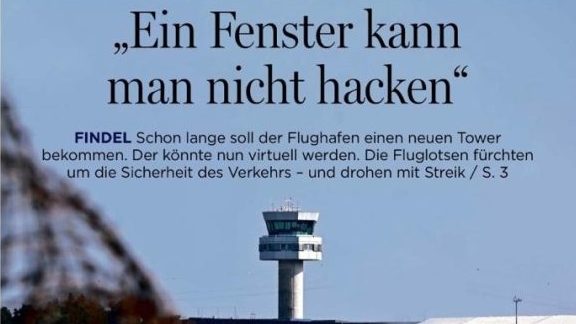
As the Guild of Air Traffic Controllers in Luxembourg, we’re not opposed to innovation, and we’re certainly not against virtual tower technology itself. However, its use must be appropriate to the environment. A remote virtual tower might work for smaller airfields, but not for a busy international airport like Luxembourg, with around 100,000 annual movements,…
Is Remote Tower Safe? Virtual Tower Safety Risks, Disadvantages, and Limitations – ELLX Feasibility Study
The Guilde Luxembourgeoise des Contrôleurs de la Circulation Aérienne (GLCCA) has been closely monitoring the evolution of remote tower technology in recent years. In doing so, we have actively engaged with industry developments, followed IFATCA and EASA guidelines, and collaborated with European counterparts to evaluate its suitability for Luxembourg Airport (ELLX). With extensive experience in…
Pressemitteilung 29.07.2025
Virtual Towers Fact Check: What’s the truth?
The basis of this fact check are statements made in response to parliamentary inquiries (“questions parlementaires”). The GLCCA would like to clarify some points here and dispel misunderstandings. „Règlement 2024/2803 relatif à la mise en œuvre du ciel unique européen qui vise à moderniser la gestion du trafic aérien (ATM) dans l’Union européenne en renforçant…