
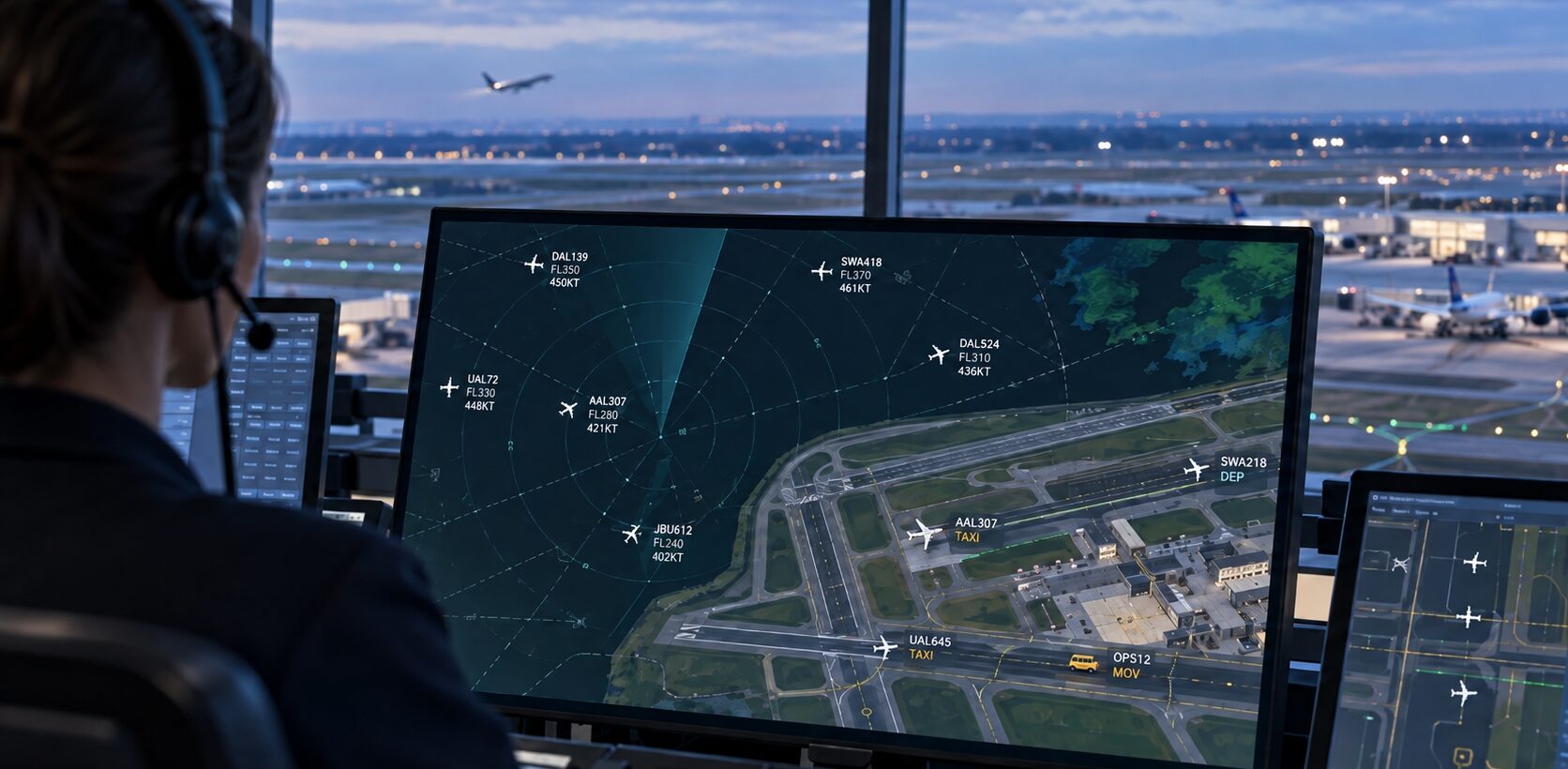
When people imagine air traffic control, they often picture controllers sitting in front of screens showing aircraft moving across a map.
And that is broadly what controllers see: traffic is presented on surveillance displays, usually as symbols or tracks with labels containing information such as the aircraft’s callsign, altitude and other flight data. At airports, those displays may also show vehicles moving on runways and taxiways.
But the picture on the screen is only the end result.
Behind those apparently simple symbols is a considerable amount of technology. Depending on the airspace, airport and equipment available, the information may come from primary radar, secondary surveillance radar, Mode S, ADS-B, multilateration, surface movement radar or a combination of several systems.
These technologies do not all work in the same way. Some can detect a target without any cooperation from it, while others receive information transmitted by the aircraft or vehicle itself.
So how does air traffic control actually see traffic?
Let’s take a closer look at the technologies that build the traffic picture controllers see on their screens.
Primary Radar: Seeing Something Without Its Help
Primary Surveillance Radar (PSR) is the traditional form of radar most people probably imagine when they hear the word “radar”.
A ground-based radar sends out radio waves. When those waves hit an aircraft, part of the signal is reflected back towards the antenna. By measuring the direction and the time it takes for the signal to return, the system can determine the aircraft’s approximate position.
The important point is that the aircraft does not have to transmit anything.
Primary radar can therefore detect a target even if its transponder is not operating.
However, the radar return itself does not automatically tell ATC what the target is. The system has essentially detected that something is present at a particular position.
Primary radar can detect a target without the target actively cooperating. Detection, however, does not automatically mean identification.
Secondary Surveillance Radar: Asking the Aircraft
Secondary Surveillance Radar (SSR) works differently.
Instead of relying on radio waves bouncing off an aircraft, the ground system sends an interrogation to equipment aboard the aircraft called a transponder. The transponder receives the interrogation and sends a reply.
This means that the surveillance system can receive information directly from the aircraft rather than relying only on a reflected radar signal.
Depending on the transponder mode and equipment, that reply can include information such as a transponder code, altitude, aircraft identity and other data.
This is known as cooperative surveillance because the aircraft actively participates in the process.
Mode A and Mode C: Squawk and Altitude
Traditional secondary surveillance commonly uses Mode A and Mode C.
Mode A allows the transponder to transmit a four-digit code assigned by ATC — the familiar squawk code.
Mode C adds pressure-altitude information.
Together, they provide considerably more information than an unidentified primary radar return, allowing the surveillance system to associate a transponder code and altitude with the detected aircraft.
Mode S: More Selective, More Information
Mode S is a more advanced form of secondary surveillance. The “S” stands for Selective.
Each Mode S-equipped aircraft has a unique 24-bit address. This allows surveillance systems to selectively interrogate individual aircraft instead of treating every transponder in the area in the same way.
Mode S can also provide additional information beyond traditional Mode A/C replies, including aircraft identification and other parameters useful to air traffic management.
This gives surveillance systems richer information and can improve the reliable identification of aircraft.
ADS-B: The Aircraft Broadcasts Its Position
ADS-B — Automatic Dependent Surveillance–Broadcast — works differently again.
The aircraft determines its position using onboard navigation systems, typically GNSS, and automatically broadcasts that position together with other information.
Suitably equipped ground stations can receive these broadcasts and feed the information into ATC surveillance systems.
Unlike primary radar, which determines a target’s position from reflected radio signals, ADS-B uses position information calculated and reported by the aircraft itself.
ADS-B is also one of the technologies behind many public flight-tracking websites and apps, although those services use their own receiver networks and may combine information from several different sources.
Multilateration: Finding a Target Through Timing
Multilateration (MLAT) uses yet another method.
Signals transmitted by an aircraft’s transponder are received by several ground stations at slightly different times.
Because the exact positions of those receivers are known, the system can compare the tiny differences in arrival time and calculate where the transmission originated.
A simple analogy would be several people standing at known locations hearing the same sound. If one person hears it slightly before another, those timing differences can help determine where the sound came from.
Unlike ADS-B, multilateration does not need the aircraft to broadcast a GNSS-derived position. The ground system calculates the position itself from the received signals.
Surveillance on the Airport Surface
Surveillance is not limited to aircraft in the air.
At larger or more complex airports, controllers may also use surveillance systems to monitor aircraft and vehicles moving on runways and taxiways. These systems are particularly valuable during darkness, poor weather or low-visibility conditions.
Surface Movement Radar (SMR) can detect aircraft and vehicles on the airport surface using primary radar principles.
That means the target does not necessarily need to carry a transponder in order to create a radar return.
But this creates an important limitation.
A controller may see that something is present without automatically knowing exactly what it is.
A primary radar return might correspond to an aircraft, a vehicle or another radar reflection or unwanted signal. Without additional information, the controller cannot simply assume that every return represents a known aircraft or vehicle.
Seeing something is not the same as knowing what it is.
Primary surveillance may tell the system that a target is present. Cooperative surveillance can add information that helps identify that target as a particular aircraft or vehicle.
This is where cooperative surveillance also becomes useful on the airport surface.
Aircraft and appropriately equipped airport vehicles can provide compatible surveillance information through systems such as multilateration, ADS-B and vehicle transponders.
This allows the surveillance system to associate additional information with a target rather than presenting only an unidentified primary return.
It is therefore misleading to say that a vehicle without a transponder is necessarily “invisible”.
If suitable primary surface surveillance is available, that vehicle may still produce a radar return.
The difference is what the controller actually knows:
Something appears to be there is very different from this is a particular aircraft or vehicle.
Operationally, that difference can matter a great deal.
A-SMGCS: Combining the Surface Picture
At airports equipped with an Advanced Surface Movement Guidance and Control System (A-SMGCS), information from several surveillance sources can be combined into one operational picture.
Depending on the installation, those sources may include surface movement radar, multilateration, ADS-B, vehicle transponders and other cooperative surveillance systems.
A-SMGCS is therefore much more than simply a radar display.
Depending on the implementation, it can support functions such as surveillance, identification, routing, guidance and conflict detection.
These capabilities can be particularly valuable in poor visibility, when controllers may not be able to visually observe every aircraft or vehicle from the tower.
Technology does not replace situational awareness. It provides much of the information controllers use to build and maintain it.
So What Does the Controller Actually See?
Controllers normally do not sit in front of separate displays labelled “radar”, “ADS-B” and “multilateration”.
Information from different surveillance sources can be processed, correlated and combined before it reaches the controller.
The result is often a single track symbol with an associated label containing information such as the aircraft’s callsign, altitude and other flight data.
Behind that apparently simple symbol can be a considerable amount of technology.
One track may be supported by several surveillance sources, while another target may only be visible through one.
On the airport surface, one target might be positively identified, while another appears only as an unidentified primary return.
The display is therefore the end result of a much larger surveillance chain operating behind the scenes.
Why Use Several Surveillance Technologies?
If ADS-B can provide highly accurate aircraft positions, why continue using radar or multilateration?
Because the different technologies have different strengths, limitations and dependencies.
Primary radar can detect targets without requiring a functioning transponder.
Secondary surveillance and Mode S receive information directly from equipped aircraft.
ADS-B can provide highly accurate position information, but it depends on aircraft equipment and onboard navigation data.
Multilateration can calculate a target’s position from transponder signals without relying on the position reported by the aircraft itself.
Surface movement radar can detect non-cooperative traffic on an airport surface, while cooperative systems can add identification and other information.
Combining different technologies can therefore improve coverage, identification and resilience.
It also reflects an important safety principle: one surveillance technology does not necessarily have to be the only source of information.
That becomes particularly important when something fails.
We explain redundancy, degraded operations and contingency systems in our related article:
What Happens When ATC Technology Fails?
Seeing Something Is Not the Same as Knowing What It Is
Perhaps the easiest way to understand modern ATC surveillance is to separate two questions:
Can the system detect something?
And:
Can the system identify what that something is?
Primary surveillance can answer the first question without requiring any cooperation from the target.
Cooperative surveillance can provide much more information for the second.
Modern ATC surveillance combines these capabilities wherever appropriate to give controllers a reliable traffic picture, both in the air and on the airport surface.
So when someone says that air traffic controllers “watch aircraft on radar”, the phrase is understandable — but the reality is considerably more sophisticated.
What appears as one simple symbol on a controller’s screen may actually be the result of several independent technologies working together behind the scenes.