
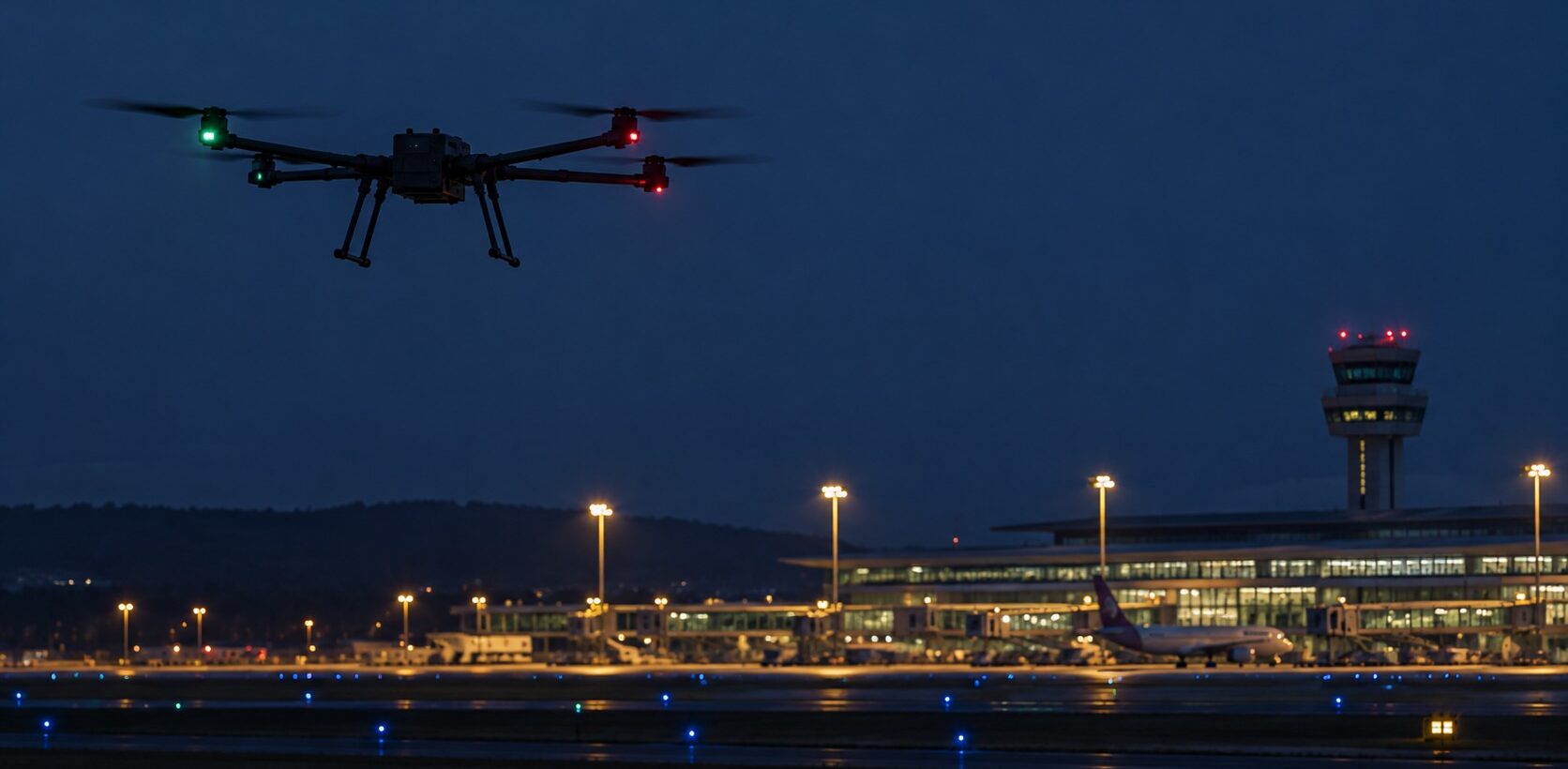
The drone incident on Friday, 18 September 2026 at Luxembourg Airport showed how quickly a few unidentified lights in the sky can have major consequences.
On Friday evening, unidentified and unauthorised drones were visually observed within the airspace over Luxembourg Airport. Operations were suspended and aircraft were diverted while the situation was assessed.
But why can a drone cause such disruption? And what can air traffic control actually do?
When Something Does Not Belong There
Tower controllers spend their working lives observing traffic around an airport.
They know where an aircraft or helicopter on final approach should appear, the typical positions of traffic on downwind, base or crosswind, and where departing aircraft will normally be seen.
More importantly, they have a detailed picture of the traffic they are controlling and monitoring at that particular moment.
This makes a significant difference when assessing a drone report.
Not every reported drone turns out to be one. Lights in the night sky can be surprisingly difficult to interpret. An aircraft in a holding pattern can appear in an unexpected part of the sky, a helicopter can be mistaken for a drone, and distance, altitude and movement can be extremely difficult to judge at night.
That difficulty was demonstrated again on Saturday evening, when the authorities reported that many suspected drone observations turned out to be navigation lights from other aircraft.
This is also true for experienced tower controllers. Being accustomed to looking for aircraft does not mean that an unfamiliar light can automatically be identified as a drone.
What tower controllers do have is an important advantage: they have the current traffic picture available to them.
On Friday, there were reports of suspected drones and tower controllers could also see unidentified lights themselves from the control tower.
Naturally, this type of visual assessment is limited to what can actually be seen from the control tower. Reports of suspected drones outside the tower’s field of view cannot automatically be confirmed or rejected visually by tower controllers.
Where an unidentified object is visible, controllers can compare what they see outside with the traffic information available to them, including displayed traffic, coordinated traffic and aircraft on frequency.
At the positions where those lights were observed, none of the traffic displayed, coordinated or on frequency corresponded to them.
Why this matters
Direct visual observation does not mean that an unidentified object can immediately be identified. It allows controllers to compare what they are seeing outside with the traffic information available to them.
The observation itself did not provide an exact altitude, distance or speed, nor did it establish with certainty what the lights were. But it provided important information: what the controllers were observing did not correspond to the traffic picture available to them.
Nobody Knows What the Drone Will Do Next
Once an unidentified object has been observed, the next challenge is establishing as much information about it as possible.
Where exactly is it? How high is it? In which direction is it moving? And can it be positively identified?
Then comes another important question: what will it do next?
An unidentified and illegally operated drone is not cooperative traffic. There is no communication with its operator, no clearance and no known flight plan.
It may remain where it is or fly away from the airport. Or seconds later, it may change direction towards a runway or the flight path of an aircraft.
ATC’s responsibility is to protect aircraft from the potential hazard.
It is not the controller’s job to locate the drone operator, take control of the drone or physically bring it down. Those tasks belong to the relevant authorities and specialised services.
Nor is it realistic to expect tower controllers to detect every drone around an airport. Their primary task is to manage and monitor air traffic. A drone may be noticed while controllers are observing that traffic, but there is no guarantee that it will be seen. Visual detection itself has limitations, whether by direct observation or camera systems, particularly with small objects at night or at significant distances.
If controllers observe an object in a position where it clearly represents an immediate danger to an aircraft, traffic is protected immediately. Arrivals or departures can be stopped and aircraft instructed accordingly.
In other situations, the available information has to be assessed continuously. The position and movement of an unidentified object may be uncertain, and the level of risk can change very quickly. Established procedures and coordination with the relevant authorities determine how operations are handled.
On Friday, the airspace was closed as a precaution and in accordance with established safety protocols.
Uncertainty is part of the risk
It is entirely possible that flights are stopped or diverted and it later turns out that the object would never have posed a direct threat. But that is hindsight. When decisions have to be made, uncertainty cannot simply be treated as an absence of risk.
The result may be delays, missed connections, diversions and considerable costs for airlines, the airport and the wider economy.
That is frustrating and expensive. But air traffic control exists first and foremost to keep aircraft and the people on board safe.
Safety has to come first. Money can be replaced. Human lives cannot.