
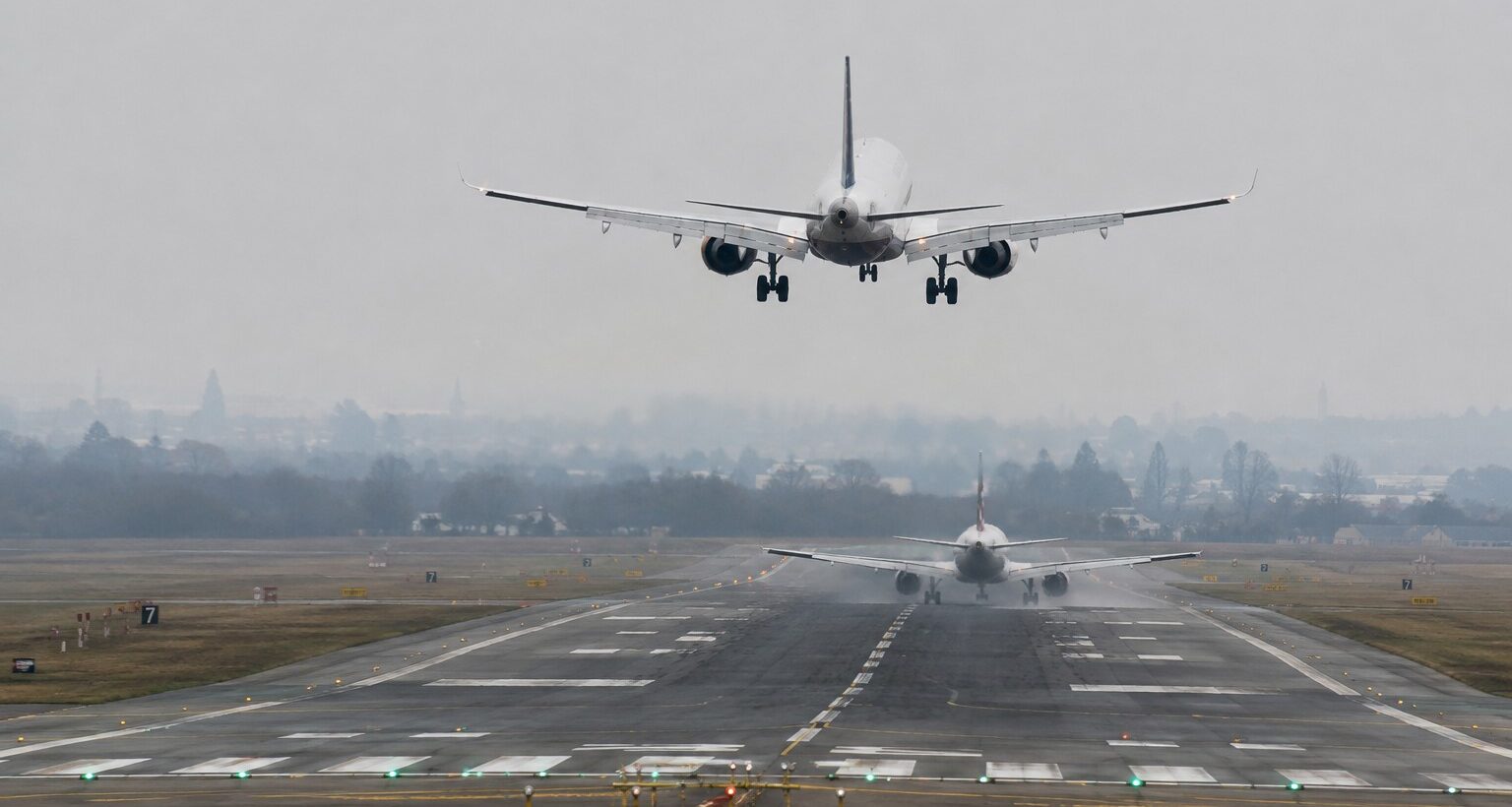
At first glance, it might seem possible for two aircraft approaching the same runway to simply continue towards it and land one after another.
In reality, the situation is normally managed long before either aircraft reaches the runway. Air traffic controllers organise arriving aircraft into a sequence and create the spacing needed between them, taking into account their speed, wake turbulence, runway occupancy, weather and the traffic situation.
What looks simple from the passenger cabin is actually a continuously changing process involving anticipation, speed control, radar vectoring and coordination between different controllers.
Aircraft Are Sequenced Long Before Landing
The process of arranging arriving aircraft into the correct order is called sequencing. Aircraft are normally organised one behind another, but the objective isn’t simply to keep them as far apart as possible.
Good sequencing is about creating the right spacing at the right time. Too little spacing may make it impossible to maintain the required separation or provide enough time for the preceding aircraft to leave the runway, but unnecessarily large gaps reduce runway capacity and create delays.
Controllers continuously adjust the arrival sequence based on factors such as:
- Aircraft speed and performance
- Wake turbulence category
- Runway occupancy
- Weather conditions
- Traffic density
- The type of approach being flown
Much of this work begins many miles from the airport. By the time aircraft are established on final approach, a considerable amount of sequencing may already have taken place.
How Air Traffic Controllers Create Landing Spacing
Aircraft do not all approach at the same speed. A large jet, a regional aircraft and a small general-aviation aircraft can have very different performance characteristics, and without intervention, a faster aircraft behind a slower one could gradually close the gap.
One of the simplest and often most effective ways of creating spacing is speed control. If an aircraft is still some distance from the airport, even a relatively small reduction in speed can make a noticeable difference. A slower aircraft covers less distance in the same amount of time, gradually creating additional spacing and giving the controller more room to build the correct sequence.
This is particularly useful when the adjustment is made early. A small speed difference maintained for several minutes can translate into valuable additional spacing by the time the aircraft reaches the final approach.
But speed control alone cannot solve every sequencing problem.
Aircraft have very different performance limits. A Boeing 747, for example, cannot simply slow to the same speed as a small single-engine aircraft such as a Piper, while the slower aircraft in front cannot necessarily speed up enough to match a faster jet behind it.
Controllers therefore combine speed control with other techniques. An aircraft may be given a different heading, flown along a slightly longer path, turned towards the final approach at a different point, or placed behind another aircraft in the sequence.
The aim is to solve spacing problems early rather than waiting until aircraft are close to the runway.
Departures Have to Be Sequenced Too
The same principle applies in the opposite direction.
Controllers cannot simply clear departing aircraft for takeoff one after another as quickly as possible. Wake turbulence can require additional spacing behind certain aircraft, with the required interval depending on aircraft categories, runway configuration and departure points used.
Aircraft performance also matters. If a slower aircraft departs ahead of a much faster one on a similar route, the faster aircraft may quickly catch up after departure.
Controllers therefore consider what will happen after the aircraft leaves the runway, not just whether the runway is currently clear.
Departure sequencing can involve:
- Changing the order of departing aircraft
- Using different runway entry points where appropriate
- Coordinating release times with another ATC unit
- Delaying takeoff clearance to create the required spacing
- Integrating departures into gaps between arriving aircraft
Again, the objective is the right spacing at the right time.
When Arrivals and Departures Share One Runway
At a single-runway airport, the challenge becomes even more interesting because arriving and departing aircraft have to be integrated into the same sequence.
A controller may have an aircraft approaching the runway while another waits for departure. Is there enough time to depart the waiting aircraft before the arrival?
The answer depends on much more than the distance of the approaching aircraft.
The controller must consider how quickly the departing aircraft can enter and use the runway, the speed of the arriving aircraft, applicable separation requirements, runway occupancy and how the overall traffic situation is developing.
Sometimes there is enough time; sometimes there isn’t.
And a gap that initially appears large may disappear surprisingly quickly when an aircraft is approaching at several kilometres per minute.
Managing both arrivals and departures on the same runway can therefore be considerably more complex than handling only one traffic flow.
At some larger airports with multiple runways, individual runway positions may predominantly handle either arrivals or departures. Even with a higher overall traffic volume, the task can in some respects be more predictable because the traffic flow is more homogeneous.
At a single-runway airport, however, the controller continuously has to fit departures into gaps between arrivals while also considering wake turbulence, aircraft performance, runway occupancy and the traffic that will develop several minutes later.
This means that a smaller airport with one runway is not automatically easier to control than a busier airport where traffic flows are more clearly separated.
This is why runway sequencing requires constant judgement and anticipation rather than simply reacting to aircraft as they reach the runway.
Why Mixed Aircraft Types Make Sequencing More Difficult
The challenge increases when aircraft with very different performance characteristics share the same runway.
A heavy long-haul aircraft, a regional jet, a business jet and a small general-aviation aircraft may all require very different speeds and amounts of time to use the runway. A sequence that works well with similar aircraft may therefore be much more difficult to achieve with mixed traffic.
Wake turbulence can add another constraint: a smaller aircraft following a much heavier one may require additional spacing because of the wake vortices generated by the aircraft ahead.
Controllers have to take those differences into account when deciding not only how much spacing is needed, but also which aircraft should follow which and where a departure can be fitted between arrivals.
Luxembourg Airport is a good example. Its single runway is used by passenger flights, heavy cargo aircraft, business aviation and general aviation, all of which may have very different performance characteristics.
The number of aircraft is therefore only part of the challenge. The mix of aircraft and how they have to share the runway can be just as important.
How Runway Occupancy Affects Landing Spacing
Spacing between aircraft in the air is only part of the problem. Controllers must also consider what is happening on the runway.
An aircraft that has just landed needs time to decelerate and vacate. How long that takes can vary considerably depending on aircraft type, runway exit used, braking conditions and other operational factors.
The following aircraft may therefore be correctly separated in the air while the runway itself is not yet available for its landing.
Landing clearances and runway use are subject to defined separation and runway-occupancy requirements, so controllers monitor both the aircraft approaching the runway and the traffic already using it.
This is why efficient arrival sequencing also depends heavily on anticipating runway occupancy time.
What Happens If the Spacing Becomes Too Small?
Sometimes the plan doesn’t work exactly as expected.
An aircraft may reduce speed earlier than anticipated, another may take longer to vacate the runway, wind conditions can change, or spacing that initially looked sufficient may gradually disappear.
If this happens early enough, controllers may still be able to adjust the sequence or create additional spacing.
But once an aircraft is established close to the runway, the available options become much more limited. If the required spacing can no longer be maintained, or the runway won’t be available when needed, the safest solution may be a go-around: the aircraft discontinues its approach, applies power, climbs away and is subsequently repositioned for another approach.
A go-around is not an emergency. It is a normal safety procedure.
Why Might an Aircraft Have to Go Around?
Insufficient spacing is only one possible reason.
A go-around may also be necessary because the preceding aircraft hasn’t vacated the runway in time, another aircraft or vehicle is occupying it, the approach has become unstable, weather or visibility conditions make continuing the approach unsuitable, wildlife or another obstruction is reported on or in the vicinity of the runway, or a technical or operational problem affects the runway.
Pilots can also initiate a go-around themselves whenever they determine that continuing the landing wouldn’t be appropriate.
For passengers, the sudden application of power and climb can feel dramatic. Operationally, it’s simply another layer of protection: the landing is abandoned before an undesirable situation is allowed to develop further.
When Do Aircraft Enter Holding Patterns?
If delays become too large to absorb through normal sequencing, aircraft may sometimes be instructed to enter a holding pattern, a predefined flight pattern that allows them to remain within a protected area while waiting for further clearance.
Holding can be used during congestion, weather disruption or runway unavailability, although traffic flow is also managed much earlier, sometimes before aircraft even depart, to reduce unnecessary airborne holding.
What Passengers Don’t See
From inside an aircraft, most of this work is invisible.
Passengers might notice the aircraft slowing earlier than expected, making a longer turn towards the airport, or remaining at the gate for another minute before departure, never knowing that those small changes were used to create exactly the spacing needed several minutes later.
The most noticeable intervention is usually a go-around because it happens close to the runway. But even then, it doesn’t necessarily mean that something has gone dangerously wrong. A go-around is itself a safety measure used when continuing the landing is no longer the preferred option.
So what happens when two aircraft want to land at the same time?
Normally, they never actually reach that situation.
Controllers begin organising the traffic well beforehand, establishing an order and continuously adjusting the spacing. One aircraft may be slowed, another vectored slightly further, the sequence may be changed, a departure may be inserted between arrivals, or an aircraft may occasionally have to go around.
What appears to passengers as a line of aircraft simply following each other towards a runway is therefore a constantly managed flow in which controllers are thinking several minutes ahead.
Good air traffic control isn’t about creating the largest possible gaps between aircraft. It is about creating the correct gaps, safely, efficiently and at exactly the right time.
FAQ
Can two aircraft land at the same time on the same runway?
Runway use is governed by defined separation and runway-occupancy requirements. In normal arrival sequencing, controllers organise aircraft so that each landing can take place with the required runway availability and separation from preceding traffic.
What is a go-around?
A go-around is a normal procedure in which an aircraft discontinues its approach to landing, climbs away and is subsequently repositioned for another approach.
Does a go-around mean something dangerous happened?
Not necessarily. A go-around is itself a safety measure and can be initiated for many reasons, including runway occupancy, insufficient spacing, weather or an unstable approach.
What does sequencing mean in air traffic control?
Sequencing is the process of arranging aircraft into an appropriate order and creating the spacing required between them.
Why don’t controllers simply leave very large gaps between aircraft?
Because runway capacity is limited. Controllers aim to provide the required safe spacing while also using the available runway efficiently.
Why can a smaller aircraft need more space behind a larger aircraft?
Larger aircraft can generate strong wake vortices. Depending on the aircraft categories and operation, additional wake-turbulence separation may therefore be required.
Is a busier airport always more difficult for an air traffic controller?
Not necessarily. Traffic volume is only one factor affecting controller workload and complexity. At some airports, arrivals and departures are handled in more clearly separated traffic flows. At a single-runway airport, one controller may have to continuously integrate arrivals and departures with aircraft of very different performance characteristics. A smaller airport can therefore present significant sequencing complexity even with fewer overall movements.