
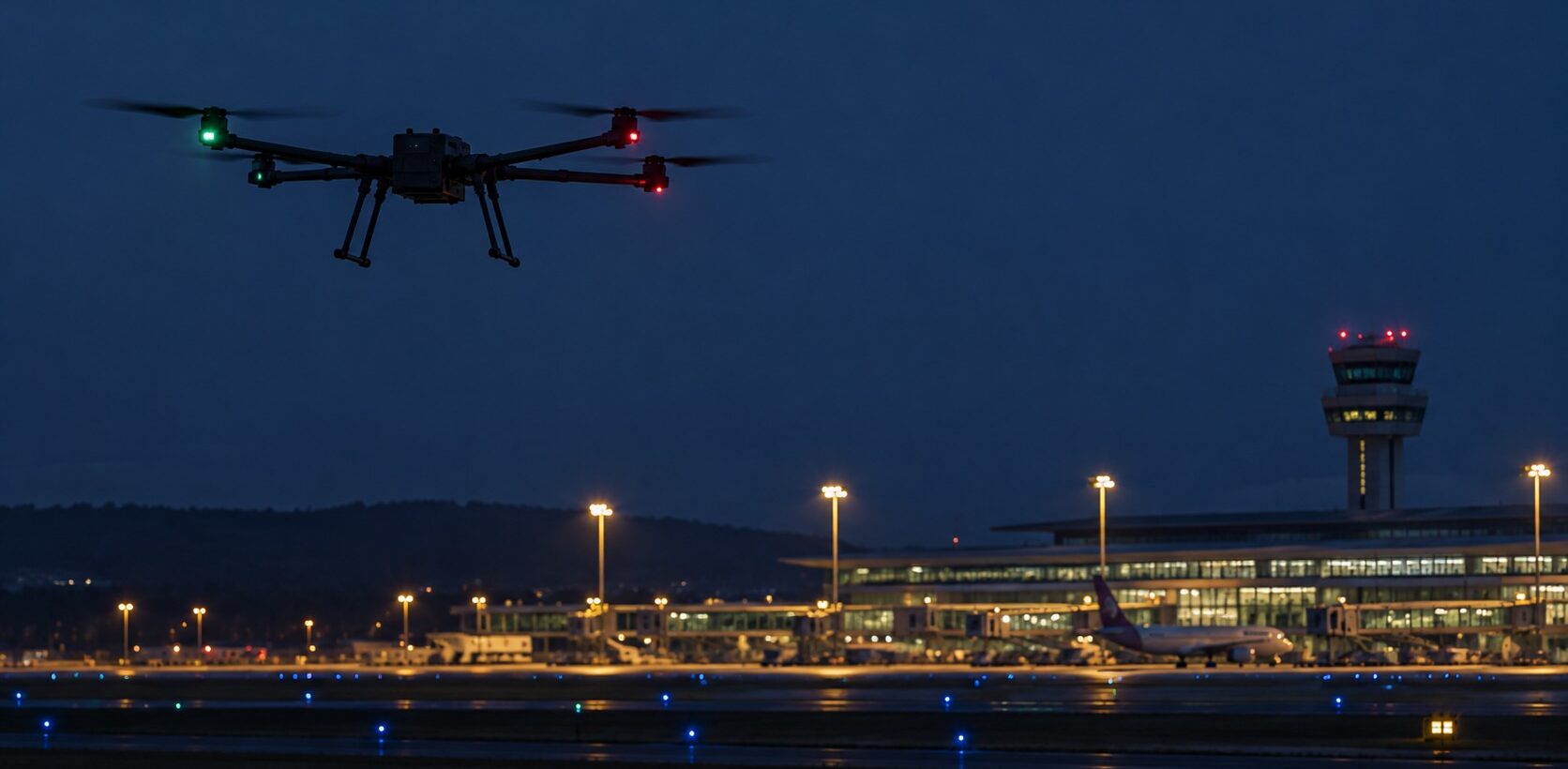
The drone incident on Friday, 18 September 2026 at Luxembourg Airport showed how quickly a few unidentified lights in the sky can have major consequences.
On Friday evening, unidentified and unauthorised drones were observed around Luxembourg Airport. Operations were suspended and aircraft were diverted while the situation was assessed.
But why can a drone cause such disruption? And what can air traffic control actually do?
When Something Does Not Belong There
Tower controllers spend their working lives observing traffic around an airport.
They know where an aircraft or helicopter on final approach should appear, the typical positions of traffic on downwind, base or crosswind, and where departing aircraft will normally be seen.
More importantly, they know which traffic is actually there at that particular moment.
This makes a significant difference when assessing a drone report.
Not every reported drone turns out to be one. Lights in the night sky can be surprisingly difficult to interpret. An aircraft in a holding pattern can appear in an unexpected part of the sky, a helicopter can be mistaken for a drone, and distance, altitude and movement can be extremely difficult to judge at night.
This is also true for experienced tower controllers. Being accustomed to looking for aircraft does not mean that an unfamiliar light can automatically be identified as a drone.
What tower controllers do have is an important advantage: they know the current traffic picture.
On Friday, there were reports of suspected drones and tower controllers could also see unidentified lights themselves from the control tower.
They could compare what they saw outside with the traffic picture they already had from known aircraft and helicopters, surveillance information and radio communications.
At the positions where those lights were observed, there was no known traffic that should have been there.
Why this matters
Direct visual observation does not mean that an unknown object can immediately be identified. It allows controllers to observe something unexpected in the context of the traffic they already know is operating around the airport.
The observation itself did not provide an exact altitude, distance or speed, nor did it establish with certainty what the lights were. But it provided important information: what the controllers were seeing did not correspond to the known traffic picture.
Nobody Knows What the Drone Will Do Next
Once an unidentified object has been observed, the next challenge is establishing as much information about it as possible.
Where exactly is it? How high is it? In which direction is it moving? And can it be positively identified?
Then comes another important question: what will it do next?
An unidentified and illegally operated drone is not cooperative traffic. There is no communication with its operator, no clearance and no known flight plan.
It may remain where it is or fly away from the airport. Or seconds later, it may change direction towards a runway or the flight path of an aircraft.
ATC’s responsibility is to protect aircraft from the potential hazard.
It is not the controller’s job to locate the drone operator, take control of the drone or physically bring it down. Those tasks belong to the relevant authorities and specialised services.
Nor is it realistic to expect tower controllers to detect every drone around an airport. Their primary task is to manage and monitor air traffic. A drone may be noticed while controllers are observing that traffic, but there is no guarantee that it will be seen. At night, a drone without visible lights may be virtually impossible to detect visually, and even with lights, identifying and tracking a small object can be extremely difficult.
If controllers observe an object in a position where it clearly represents an immediate threat to an aircraft, there is no ambiguity: traffic is protected immediately. Arrivals or departures can be stopped and aircraft instructed accordingly.
The more difficult situation is when an unidentified object has been observed, but its exact position, movement, identity or intentions remain uncertain. In that case, established procedures and coordination with the relevant authorities determine how operations are handled.
Uncertainty is part of the risk
It is entirely possible that flights are stopped or diverted and it later turns out that the object would never have posed a direct threat. But that is hindsight. When decisions have to be made, uncertainty cannot simply be treated as an absence of risk.
The result may be delays, missed connections, diversions and considerable costs for airlines, the airport and the wider economy.
That is frustrating and expensive. But air traffic control exists first and foremost to keep aircraft and the people on board safe.
Safety has to come first. Money can be replaced. Human lives cannot.
What Does This Mean for the Future Control Tower?
The incident is particularly relevant while Luxembourg is planning its future control tower.
Friday demonstrated the value of controllers having a direct view of what is happening around the airport. It also demonstrated the limitations of visual observation alone.
Seeing an unidentified light does not necessarily tell a controller what it is, how far away it is or at what altitude it is flying. And, as explained above, controllers cannot be expected to visually detect every drone around an airport.
Technology can provide additional information, but here too it is important to distinguish between different capabilities.
Modern camera systems are increasingly promoted as capable of automatically detecting and tracking objects, with infrared technology providing additional capability at night. These systems can certainly be useful, particularly for providing an enlarged view or helping to follow an object that has already been detected. But cameras should not be regarded as a guaranteed drone detection system. Small objects at significant distances, difficult lighting conditions and complex backgrounds remain challenging to detect and identify reliably.
There is also a fundamental difference between a wide direct view and a camera looking at a particular part of the airport environment. A zoom camera may provide a much more detailed image of a specific area, but it has to be directed towards that area, either by the controller or with the help of another detection system.
From a physical tower, controllers can observe the wider airport environment directly. If something attracts their attention, binoculars provide a simple way of immediately examining that particular area more closely. Cameras can provide another valuable source of information, particularly when they are directed towards an object by the controller or by a dedicated detection system.
Recent incidents at European airports also show that human sightings continue to play an important role. Despite increasingly sophisticated camera and surveillance technology, several major drone disruptions have still begun with reports or visual observations rather than automatic camera detection.
This is why dedicated drone detection should not depend on cameras alone. Systems specifically designed for this purpose can combine different technologies, including radar, radio frequency detection and optical sensors. Together, these can help establish that an object is present, determine its position and follow its movement much more accurately than visual observation alone.
Following Friday’s incident, Luxembourg deployed additional detection assets to strengthen its ability to monitor and assess such situations.
As Luxembourg plans its future control tower, such developments are particularly relevant. Dedicated detection systems could provide controllers with valuable additional information about the position and movement of unidentified objects around the airport.
The objective should not be to replace one source of information with another, but to combine complementary capabilities.
A controller in a physical tower can have both: a wide direct view of the airport and additional technology that improves situational awareness.
Direct visual observation may provide one part of the picture. Cameras can provide a closer or enhanced view. Dedicated detection systems can provide another layer of information. The important question is how these capabilities are combined and how quickly relevant information reaches those managing the traffic.
But even with better detection and better information, one fundamental problem remains: neither visual observation nor technology can reliably predict where an unidentified drone will go next.
And that uncertainty is precisely what makes an illegal drone close to an active airport so difficult to manage.