
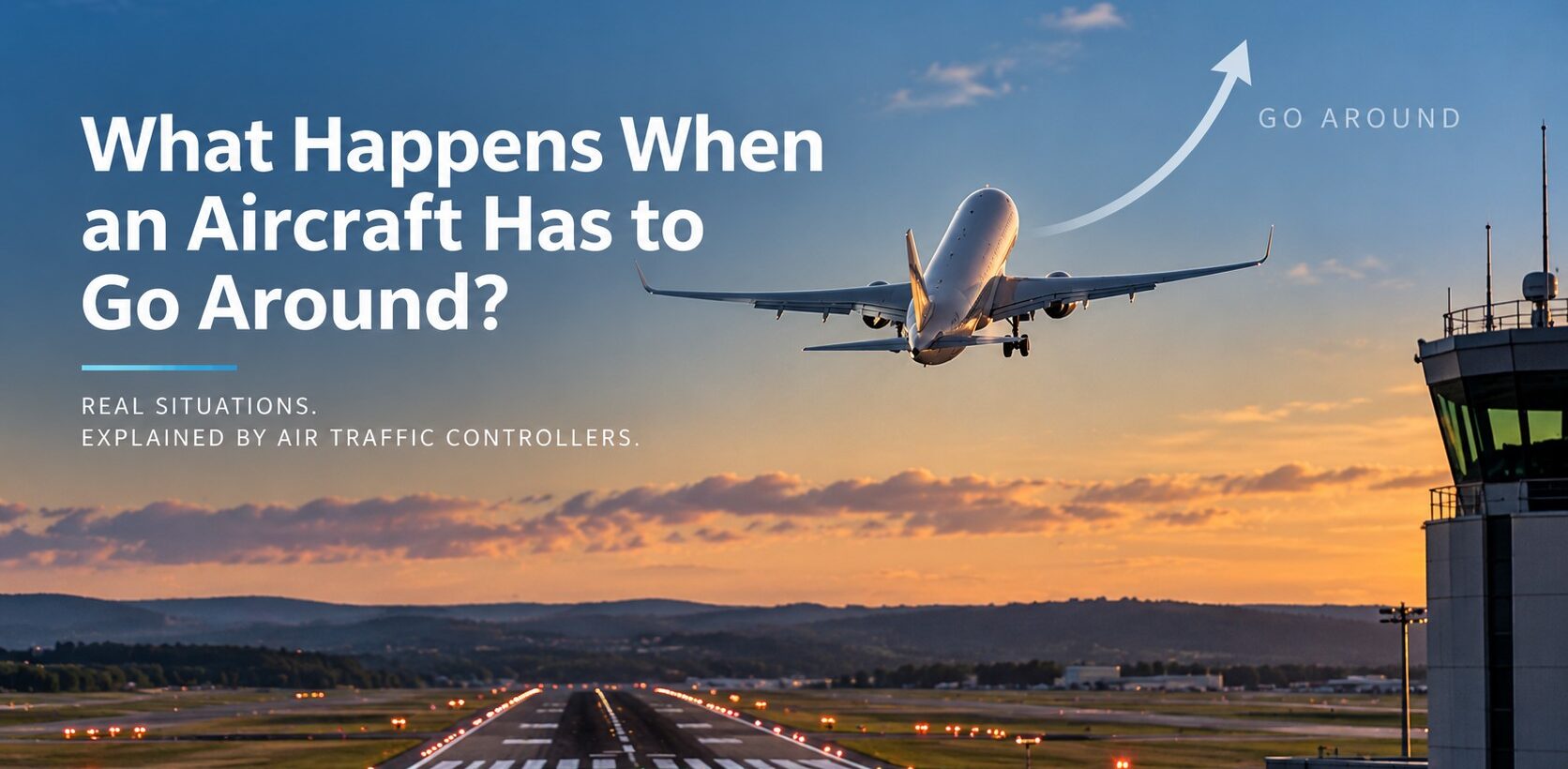
A go around can look dramatic from the ground. An aircraft is approaching the runway, everything appears normal, and then suddenly the engines become louder, the aircraft climbs away and the landing does not happen.
For passengers, it can be unexpected. For air traffic controllers and pilots, however, a go around is a completely normal procedure.
So why does it happen, and what does ATC do when an aircraft that was about to land suddenly starts climbing again?
A Go Around Is Not an Emergency
The first thing to understand is that a go around does not normally mean that something has gone seriously wrong.
Quite the opposite.
A safe landing requires certain conditions to be met. If the pilots or the controller are not satisfied that the approach can continue safely, the safest option may simply be to stop the approach and try again.
A go around is a safety manoeuvre, not a failed landing.
And it can be initiated by either the pilot or air traffic control.
Why Would an Aircraft Go Around?
There are many possible reasons.
The aircraft ahead may not have vacated the runway quickly enough. Another aircraft or vehicle may still be on the runway. The spacing between two arriving aircraft may become insufficient.
Weather can also play a role. A sudden change in wind, poor visibility or an unstable approach may make continuing the landing undesirable.
Sometimes the reason is much simpler. The pilots may decide that the aircraft is too high, too fast or simply not correctly positioned for a safe landing.
In other cases, ATC may instruct the aircraft to go around because the runway is no longer available or because the required separation cannot be maintained.
Who decides?
Both the pilot and air traffic control can initiate a go around. A pilot can discontinue an approach whenever necessary for safety. ATC can also instruct an aircraft to go around when the traffic situation or runway conditions require it.
What Happens in the Control Tower?
For the tower controller, a go around immediately changes the traffic situation.
An aircraft that was expected to land and leave the runway is now airborne again and climbing.
The controller must ensure that its flight path remains safely separated from other traffic.
This is particularly important if another aircraft has just departed, is waiting for departure, or if there is other traffic operating close to the airport.
The controller gives the aircraft the appropriate instructions and coordinates with the approach controller when necessary.
At the same time, the rest of the traffic does not simply disappear. Other arriving aircraft may still be approaching the airport and departures may be waiting at the runway.
The go around therefore has to be integrated into the existing traffic sequence.
Where Does the Aircraft Go?
An aircraft performing a go around does not simply climb in any direction.
Published procedures and ATC instructions determine what happens next.
Depending on the airport and the situation, the aircraft may initially follow the published missed approach procedure or receive instructions from ATC.
Once the aircraft is safely integrated back into the traffic flow, it can normally be positioned for another approach.
That may mean being vectored around for another attempt, or in some situations entering a holding pattern before returning.
For passengers, this can mean several additional minutes in the air. Operationally, however, the objective is straightforward: create another safe opportunity to land.
What Happens to the Aircraft Behind?
This is where a single go around can become interesting from an air traffic control perspective.
Imagine several aircraft arriving one after another.
The first aircraft lands. The second is on final approach. A third aircraft is following behind it.
If the second aircraft suddenly goes around, the controller now has an aircraft climbing away while another aircraft is still approaching from behind.
The situation must be managed so that the aircraft remain safely separated.
The aircraft behind does not have to go around as well. Depending on the positions of the aircraft, the available separation and the instructions given, its approach may continue normally.
But a go around can affect the sequence. Controllers may need to adjust headings, speeds or the order in which aircraft return for another approach.
This is one reason why controllers continuously think ahead rather than dealing only with what is happening at that exact second.
What If the Pilot Goes Around Without ATC Telling Them?
That is completely possible.
The final decision to land remains with the pilot.
If the crew determines that the approach is unstable, the runway cannot be used safely or something simply does not look right, they can initiate a go around.
They do not need to continue an approach simply because they have received a landing clearance.
Once the go around has started, the crew informs ATC and the controller incorporates the aircraft back into the traffic situation.
For the controller, the important thing is not whether the go around was planned several seconds earlier. It is ensuring that the new flight path remains compatible with all the other traffic.
Can the Aircraft Try Again?
In most cases, yes.
If the reason for the go around was temporary, such as another aircraft still occupying the runway, the aircraft can usually return for another approach.
A few minutes later, it may land completely normally.
There are situations where another approach may not be possible. Weather may deteriorate, the airport may become unavailable, or the aircraft may eventually need to divert because of fuel or other operational considerations.
But a single go around by itself normally does not mean that the flight will divert.
Nothing Has Gone Wrong by Going Around
Passengers sometimes interpret a go around as something that should not have happened.
From an aviation safety perspective, that is the wrong way to look at it.
Pilots and controllers always have the option of abandoning an approach when the conditions for a safe landing are not satisfied.
There is no prize for forcing an aircraft onto the runway on the first attempt.
The engines become louder, the aircraft climbs away, ATC reorganises the traffic and another approach can be made.
Sometimes the safest landing is the one you decide not to make yet.