
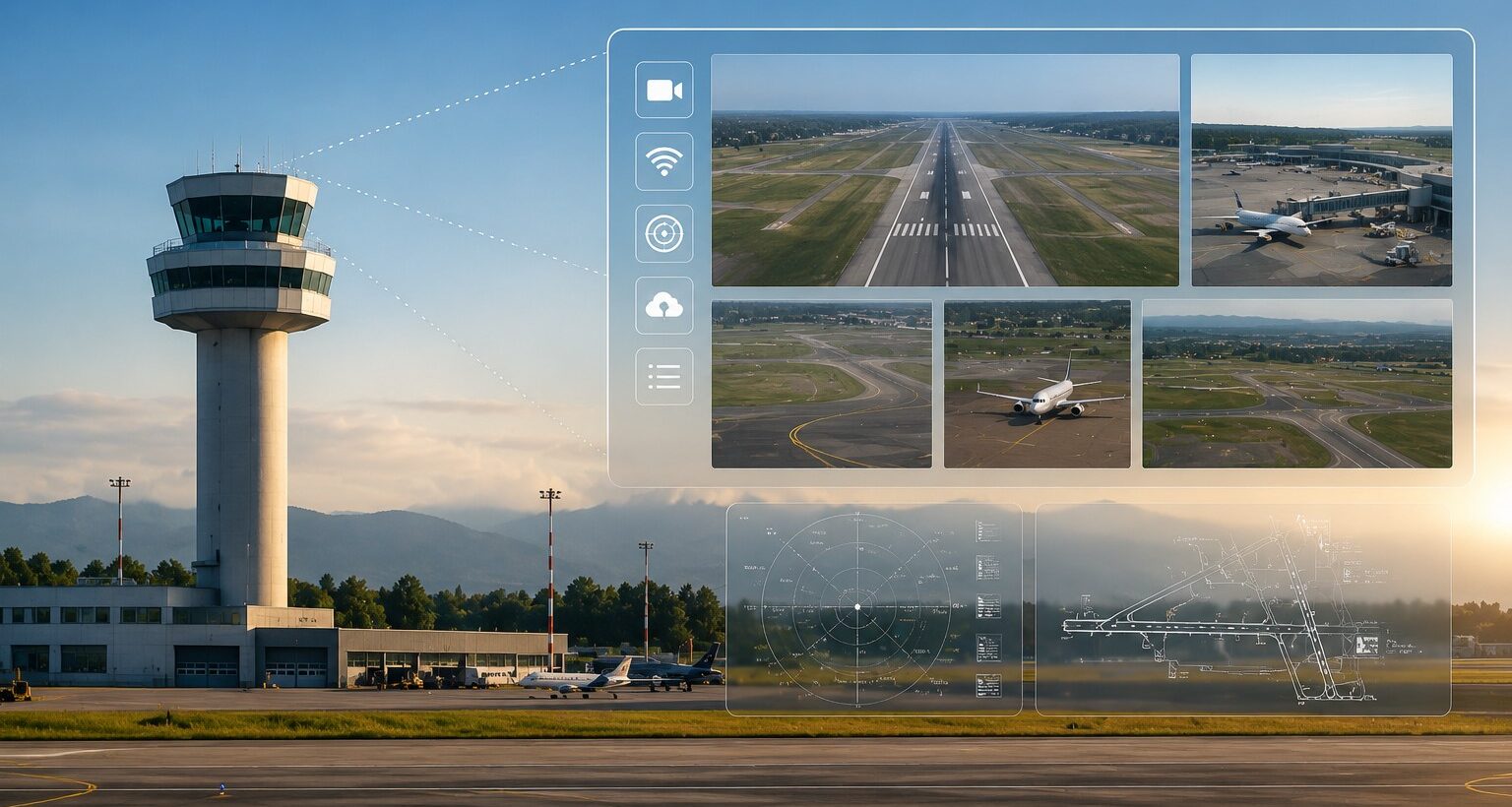
Remote tower technology has become one of the most discussed developments in modern air traffic control. For some airports, it may offer useful operational flexibility, improved opening hours or a realistic contingency solution. However, the suitability of remote towers depends strongly on the complexity of the airport.
A small airport with limited traffic is not comparable to a regional airport with 80,000 to 120,000 annual movements, and neither is comparable to a major airport with more than 120,000 movements per year. The operational environment, traffic mix, runway layout, visibility requirements, helicopter activity, ground movements and fallback needs all change the risk picture.
Remote Towers Are Not One Solution for All Airports
The term “remote tower” often creates the impression that the same concept can be applied everywhere. In reality, airports differ significantly. A solution that may be acceptable at a low-density aerodrome cannot automatically be transferred to a busy airport with mixed traffic, helicopter operations, runway crossings, training flights, cargo activity, low-visibility procedures or complex ground movements.
For this reason, airport complexity is often more important than the number of movements alone. Annual movement figures are useful, but they do not tell the whole story. A relatively low number of movements can still be operationally demanding if the airport handles very different aircraft types, unpredictable VFR traffic, helicopters or frequent vehicle movements across active areas.
Airport Categories and Remote Tower Suitability
Smaller Rural Airports
Typical profile: up to around 15,000 annual movements, low traffic density, simple runway and taxiway layout, limited aircraft diversity and mostly predictable operations.
Remote tower suitability: generally feasible, provided the system is properly certified, maintained and supported by robust fallback procedures. This is the environment where remote tower technology can make the most operational sense.
Small Airports
Typical profile: up to around 80,000 annual movements, potentially more diverse traffic, occasional peak periods, more ground coordination and greater dependence on local procedures.
Remote tower suitability: requires very careful assessment. Depending on the traffic mix, runway layout, VFR activity, helicopter operations and ground movements, complexity may already exceed what current remote tower systems can safely support as a daily operational concept.
Medium to Bigger Airports
Typical profile: around 80,000 to 120,000 annual movements, higher traffic density, mixed operations, more complex ground movements, higher peak workload and stronger resilience requirements.
Remote tower suitability: currently highly questionable for normal daily operations. Conventional or hybrid tower concepts remain the more proven and safer solution for this level of airport complexity.
Large Airports
Typical profile: more than 120,000 annual movements, high traffic density, complex ground operations, multiple operational dependencies, demanding peak periods and major resilience requirements.
Remote tower suitability: not suitable as a normal daily operating concept with current technology. For large airports, a conventional tower or a hybrid tower with direct visual observation remains the only realistic and proven approach.
Smaller Rural Airports: Where Remote Towers May Make Sense
Remote tower technology may be useful at smaller rural airports with very limited traffic, simple layouts and mostly predictable operations. In this category, up to around 15,000 annual movements, the operational picture is usually easier to reproduce on screens. Traffic density is low, aircraft diversity is limited and runway or taxiway layouts are generally less complex.
For these airports, a remote tower can offer practical advantages. It may allow an air navigation service provider to extend operating hours, centralise services, improve staffing flexibility or maintain air traffic services where a fully staffed local tower would be difficult to justify economically.
This does not mean that remote towers are risk-free. Camera quality, latency, weather performance, cybersecurity, maintenance and fallback procedures remain important. However, the operational environment at a smaller rural airport may provide enough margin for such a system to work safely if it is properly designed, certified, staffed and maintained.
Remote towers can be reasonable where traffic is very low, the runway layout is simple, VFR activity is predictable and the service improves availability without reducing safety.
Small Airports up to 80,000 Movements: Careful Assessment Required
Airports with up to around 80,000 annual movements are no longer automatically simple from an operational perspective. Even if they are still considered small compared with major airports, they may already have commercial traffic, business aviation, general aviation, training flights, helicopters, emergency services, cargo activity or more demanding ground movements.
At this level, remote tower feasibility becomes a case-by-case question. Some airports may still have a simple layout and predictable traffic patterns. Others may already have a traffic mix or operating environment where screen-based observation becomes significantly more demanding.
The decisive factor is not only the movement number. The real question is whether the remote tower system can provide the same level of situational awareness, operational flexibility and resilience that controllers need during busy periods, abnormal situations, technical degradation or poor weather.
Up to around 80,000 movements, remote tower operations require very careful operational assessment. Depending on traffic mix, VFR activity, helicopter operations, runway crossings and local complexity, the airport may already exceed what current remote tower systems can safely support as a daily operating concept.
Medium to Bigger Airports: 80,000 to 120,000 Movements
Airports with around 80,000 to 120,000 annual movements form a much more critical category. These airports often have significant peak periods, mixed traffic, more complex ground coordination and higher workload. They may not be major hubs, but they can already be operationally demanding.
Controllers at this level may need to process many different types of information simultaneously. They must maintain situational awareness across the runway, taxiways, aprons, final approach, traffic circuit and vehicle movements. The work is not only about seeing aircraft on a screen. It is about understanding the entire live environment and anticipating how it will develop.
This is where daily remote tower operations become highly questionable. Even if the system works technically in normal conditions, it must also support controllers during peak traffic, weather changes, abnormal situations, emergencies, runway inspections, towings, helicopter operations or unexpected vehicle movements.
Why the 80,000 to 120,000 Movement Range Matters
At this traffic level, a quiet period can look manageable, while a busy wave with arrivals, departures, ground movements and changing weather can become highly demanding. Remote tower systems must therefore be assessed against the most complex realistic conditions, not only against average traffic levels or quiet periods.
The key question is not whether a remote tower can handle a simple sequence. The question is whether it can safely support controllers when workload, traffic mix, weather, technical reliability and human factors all interact at the same time.
For airports between around 80,000 and 120,000 movements per year, full remote tower operations are currently highly questionable for normal daily use. Conventional or hybrid tower concepts remain the more proven and safer solution.
Large Airports Over 120,000 Movements: Not a Realistic Daily Concept
Airports with more than 120,000 annual movements have a completely different operational risk profile. They usually require continuous high-capacity operations, complex coordination, strong resilience and rapid decision-making under pressure. Even small reductions in situational awareness or traffic throughput can have significant safety and efficiency consequences.
At large airports, remote tower operations face major limitations. Controllers may need to manage dense arrival and departure flows, several apron areas, complex taxi routes, vehicles, runway crossings, runway inspections, low-visibility procedures, emergency services and irregular operations. These environments are too dynamic to be assessed through camera image quality alone.
For such airports, the main concern is not whether cameras can produce a high-resolution image. The concern is whether a remote system can reproduce the complete operational picture: peripheral vision, depth perception, natural weather cues, sound, instant spatial awareness and the ability to detect unexpected movement across a wide airport environment.
At this level of complexity, a fully remote tower is not a realistic daily operating concept with current technology. A conventional tower remains the only proven concept for normal daily tower operations. Hybrid concepts, where controllers retain direct visual observation while receiving support from cameras, surveillance data or enhanced visual tools, may offer a more realistic path forward.
For airports above around 120,000 annual movements, full remote tower operations should not be considered a normal daily operating concept. The operational complexity, resilience requirements and safety implications are too high. Conventional or hybrid towers remain the proven solution.
Safety Risks and Limitations
Situational Awareness
In a conventional tower, controllers observe the airport directly. They use visual cues, peripheral vision, depth perception, weather perception and sometimes sound to build a mental picture of the operation. Remote towers replace this direct view with camera images and screen-based information.
For small airports this may be acceptable. For complex airports, the loss of natural situational awareness can become a serious operational limitation, especially when several events happen at the same time.
Latency and Technical Degradation
Even small delays or degraded image quality can matter in dynamic situations. A frozen camera feed, network issue or delayed image may not be obvious immediately, but it can affect the controller’s ability to react to unexpected traffic, runway incursions or emergency situations.
Camera Coverage and Blind Spots
Camera systems can provide excellent views in selected directions, but they still depend on correct placement, image quality, maintenance and coverage. Small objects, wildlife, foreign object debris, vehicles or aircraft outside the main focus area may be harder to detect than from a well-positioned tower with direct visibility.
Cybersecurity and System Dependency
Remote towers depend on digital infrastructure. This introduces cybersecurity and system-dependency risks that are different from those of a conventional tower. A camera, network, display or software failure affects not only support tools, but potentially the controller’s main visual source.
Economic Benefits Must Be Proven, Not Assumed
Remote towers are often presented as cost-saving solutions. This may be true in specific cases, especially when one remote centre can provide services to several small airports. However, at more complex airports, the economic argument becomes less clear.
High-resolution cameras, low-latency networks, redundant power supply, cybersecurity measures, technical maintenance, software updates, controller training, fallback systems and permanent specialist support all create significant costs. If the system also reduces traffic capacity or requires more conservative procedures, the economic benefit may disappear.
Hybrid Towers May Be the More Realistic Path
For medium to large airports, a hybrid tower concept may offer a more balanced approach. In a hybrid tower, controllers retain direct visual observation from the tower while receiving additional support from cameras, surveillance data, zoom functions, overlays or other digital tools.
This allows technology to support the controller without removing the proven advantages of the physical tower view. The direct view remains available, while digital tools can improve specific tasks such as zooming, monitoring blind spots, recording information or supporting contingency procedures.
For many complex airports, the future may therefore not be a fully remote tower, but a smarter conventional tower: one that combines direct visual observation with carefully selected digital assistance.
Conclusion: Complexity Should Decide the Concept
Remote tower technology should not be accepted or rejected as a general idea. Its suitability depends on the airport where it is intended to be used. A small rural aerodrome, a regional airport and a large high-density airport are not comparable operational environments.
At smaller rural airports with up to around 15,000 movements per year, remote towers may be feasible if the operation is simple, traffic is predictable and robust fallback procedures are in place. At small airports up to around 80,000 movements, feasibility already requires very careful case-by-case assessment, because traffic mix, VFR activity, helicopters, runway crossings or local complexity may already create significant limitations.
At medium to bigger airports with 80,000 to 120,000 annual movements, daily remote tower operations are currently highly questionable. These airports can already have demanding peak periods, mixed traffic, complex ground movements and high resilience requirements. At large airports with more than 120,000 movements, full remote tower operations should not be considered a realistic daily operating concept under current technological and operational conditions.
The more complex the airport, the more important direct situational awareness, resilience, fallback capability and human performance become. Technology can support air traffic controllers, but it must not reduce safety margins or replace proven operational capabilities before it has been validated under truly comparable conditions.
Remote towers may be appropriate for selected smaller rural airports and for contingency purposes. For small airports with more complex operations, they require careful assessment. For medium, bigger and large airports, especially those with high movement volumes, mixed traffic and complex ground operations, conventional or hybrid tower concepts remain the safer and more proven solution today.